
Where Is Whitefish Point?
Whitefish Point sits in Whitefish Township in Chippewa County, about 11 miles north of the small town of Paradise. From Paradise, follow M-123 to Whitefish Point Road and drive north until the road ends at the lighthouse. Along the way you pass through quiet pine forest with glimpses of Whitefish Bay on your right. The point itself is a sandy spit of beach, dunes, and low jack pine, with Lake Superior on three sides. On a clear day you can watch freighters slowly rounding the point on their way to and from Sault Ste. Marie.
Nearby: Tahquamenon Falls State Park, Paradise, Vermilion Point, Crisp Point Lighthouse, and Sault Ste. Marie.
See more rockhounding spots on our full Map of the Area
A Gathering Place for Thousands of Years
Long before there was a lighthouse, Whitefish Point was a stopping place on the water highway of the upper Great Lakes. Anishinaabe (Ojibwe) people fished and traveled these shores for generations, and the rich whitefish of the bay — the fish the point is named for — fed families all along Lake Superior. Later, French voyageurs and fur traders paddled past in birchbark canoes, and Jesuit missionaries traveled the same route. A Michigan historical marker at the site honors the point as an early meeting place for Native peoples, fur traders, and missionaries. A small settlement grew up at the point in the 1870s, and Whitefish Point had its own post office from 1877 until 1974.
The Whitefish Point Light
As shipping on Lake Superior grew in the 1840s, Whitefish Point became one of the most important navigation marks on the lake. Construction began in 1847, and the first light was lit in 1849, making it the oldest active lighthouse on Lake Superior. The tower you see today was built in 1861. It's an unusual iron-and-steel skeleton tower, designed so the fierce winds off the lake could blow right through it. The 1861 keeper's quarters still stand and have been restored to how they looked in the 1920s. The light was automated in 1971 and is now controlled remotely from Sault Ste. Marie. The light station was added to the National Register of Historic Places in 1973.
The Graveyard of the Great Lakes
The stretch of Lake Superior shoreline from Whitefish Point west toward Grand Marais has been called the "Shipwreck Coast," and the waters around the point have claimed more vessels than any other part of Lake Superior. Ships traveling the full length of the lake meet here at a narrow turning point, often after days of storms with nowhere to shelter. Fog, snow squalls, and huge waves built up over hundreds of miles of open water have sent many ships to the bottom. The earliest known loss here is the trading ship Invincible in 1816. Other wrecks in the area include the Comet, the Samuel Mather, and the Vienna. To help save sailors, the U.S. Life-Saving Service built stations along this coast in the 1870s, including one at nearby Vermilion Point, where crews launched surfboats into the storm to rescue shipwrecked crews. Today the Whitefish Point Underwater Preserve protects many of these wrecks for scuba divers to explore.
The Edmund Fitzgerald
The most famous shipwreck of all happened just off Whitefish Point. On November 10, 1975, the giant ore freighter SS Edmund Fitzgerald was caught in a violent November storm while racing for the shelter of Whitefish Bay. She sank about 17 miles from the point, and all 29 crew members were lost. The ship's bell was recovered from the wreck in 1995 and is now the centerpiece of the Great Lakes Shipwreck Museum, displayed as a memorial to the Fitzgerald crew and to all the sailors lost on the Great Lakes. Every November, a memorial ceremony is held at the museum and the bell is rung for each crew member.
The Great Lakes Shipwreck Museum
The Great Lakes Shipwreck Historical Society runs the museum at the lighthouse complex. It first opened to the public in 1985, and today it includes shipwreck exhibits and artifacts, the Edmund Fitzgerald bell, the restored 1861 keeper's quarters, and a surfboat house with a full-size replica life-saving surfboat. The museum is seasonal, so check its website for current hours and admission before you go.
A Highway for Birds
Whitefish Point is one of the best places in North America to watch bird migration. Birds flying north in spring funnel up the peninsula to the point before crossing Lake Superior, and in fall huge flocks follow the shoreline south. The Whitefish Point Bird Observatory, started in 1978 and affiliated with Michigan Audubon, counts hawks, owls, and waterbirds here every spring and fall. As many as 18,000 to 21,000 red-necked grebes pass the point each fall. Federally endangered piping plovers returned to nest here in 2009 after a 23-year absence, and part of the beach is protected nesting habitat.
Why Rockhounds Love Whitefish Point
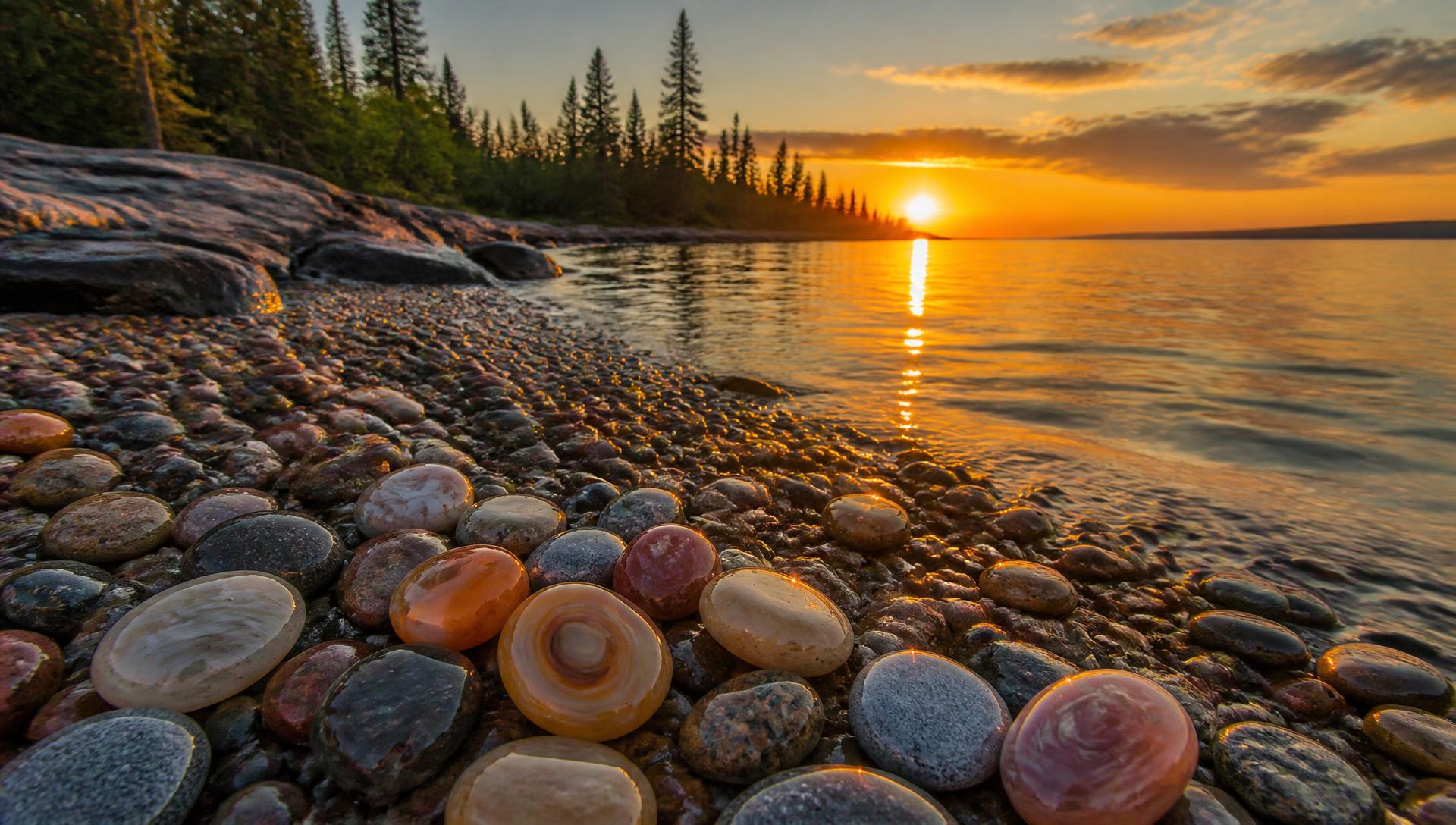
Ask any Lake Superior rock lover about Whitefish Point and you'll hear about the beach. Instead of fine sand, much of the shoreline is a wide band of colorful, water-polished stones and pebbles that rattle and shift with every wave. Here's why it's so special:
- Rocks from the north: During the last Ice Age, massive glaciers pushed down from Canada and scraped up rocks from all around the Lake Superior basin. When the ice melted, those rocks were left behind. Lake Superior's waves keep tumbling them, sorting them, and washing new ones up on the beach every storm season.
- A natural rock collector: Because the point juts out into the lake, it catches stones from wind and waves coming from several directions. After big fall storms and spring ice break-up, the beach can look completely different.
- Huge variety: Rock lovers come here for the sheer mix of colors — pink and red granite, gray and black basalt, white and rose quartz, red jasper, green-and-pink unakite, and sand streaked black with magnetite.
- Lake Superior agates: Many rockhounds come hoping to spot a Lake Superior agate. These banded beauties formed about 1.1 billion years ago when mineral-rich water filled gas bubbles in ancient lava flows. Iron in the water gave them their famous reds and oranges. Glaciers later broke them free and spread them across the region.
- Yooperlites: The eastern UP's Lake Superior shore is also where Yooperlites were first identified in 2017 — gray syenite stones that glow bright orange under a UV light at night. (Note: the refuge at Whitefish Point is day-use only, so night hunting is not allowed there.)
- Beauty and history together: Where else can you study a beach full of stones while freighters pass by, a historic lighthouse stands behind you, and hawks fly overhead? For many of us, a day at Whitefish Point is as much about the experience as about what we find.
Rocks you may see at Whitefish Point
- Lake Superior agate
- Red jasper
- Unakite
- Granite
- Basalt
- Quartz
- Magnetite sand
- Yooperlites (night only, elsewhere)
Important: The Rock Collecting Rules at Whitefish Point
Much of the beach at Whitefish Point is part of the Whitefish Point Unit of Seney National Wildlife Refuge, which is federal land. On the refuge:
- Rock collecting and driftwood collecting are NOT allowed.
- The area is open for daylight use only — no night visits, so no Yooperlite hunting.
- Dogs must be on a leash and are not allowed in the piping plover nesting area.
- Drones, camping, fires, and overnight parking are not allowed.
Please follow all posted signs. At Whitefish Point, enjoy the rocks the way we enjoy the birds: look closely, take photos, and leave them on the beach for the next person to discover.
Where You CAN Collect Nearby
Michigan allows rock collecting on state-owned land and on the Great Lakes shoreline below the ordinary high-water mark, with a limit of 25 pounds per person per year. Some good options in the Eastern UP:
- Muskallonge Lake State Park — a club favorite, with a Lake Superior beach where collecting is allowed within the state limit, and a great spot for Yooperlite hunting after dark.
- Vermilion Point — a Little Traverse Conservancy nature preserve west of Whitefish Point. It's piping plover habitat, so follow posted rules, keep dogs off the beach May 1 – August 15, and take very little.
- Other public Lake Superior shoreline — always check who owns the land, obey posted signs, and never collect on private property without permission.
Rules can change, so check with the land manager before you go.
Tips for Visiting Whitefish Point
- Best times: Late spring and fall bring the best bird migration and fresh rocks after storms. Summer is the warmest and busiest.
- Dress in layers: Even in summer, the wind off Lake Superior can be cold.
- Bring: Binoculars, a camera, water, and sturdy shoes for walking on loose stones.
- Stay safe: Lake Superior is cold and can have strong waves and currents. Watch the water and keep kids close.
- Make a day of it: Pair your visit with Tahquamenon Falls, a meal in Paradise, and a stop at Vermilion Point or Crisp Point Lighthouse.
- Where to stay: See our Places To Stay page.
Whitefish Point and the Eastern UP Rock Club
Whitefish Point is one of the select spots around the Eastern UP where our club gets together in person in late spring and fall. Come for the history, the birds, and the stones — and meet fellow rock lovers along the way. Membership is free for a limited time.
FAQ
Sources: U.S. Fish & Wildlife Service – Seney National Wildlife Refuge; Great Lakes Shipwreck Historical Society; Whitefish Point Bird Observatory / Michigan Audubon; Michigan Historical Marker #272; Michigan EGLE.